Vai al contenuto
1 Order = 1 Tree Planted 🌲
20% Off Your First Order — Sign Up to Unlock

The Moissanite Insider

Moissanite: The Smartest Diamond Alternative for Budget-Conscious Luxury in 2026

di HHTang 02 Feb 2026 0 commenti
Moissanite: The Smartest Diamond Alternative for Budget-Conscious Luxury in 2026

For many people choosing fine jewelry today, the question is no longer simply “diamond or nothing.” There are more gemstone options available than ever, each with its own appearance, properties, and value.

Among them, moissanite has become a popular diamond alternative because it combines strong brilliance, excellent hardness, and a generally lower price point than comparable diamond jewelry.

But choosing moissanite should not be about finding a “fake diamond” for less. It is better understood as a distinct gemstone with its own optical character and advantages.


What Makes Moissanite a Good Diamond Alternative?

Moissanite works well as a diamond alternative because it offers several qualities people often look for in frequently worn jewelry: brightness, durability, a colorless appearance, and flexibility in stone size and design.

It is made from silicon carbide, while diamond is made from carbon. Although the two gemstones can look similar at a glance, especially in classic colorless cuts, they are different materials and should be appreciated as such.

For shoppers who enjoy a bright, refined look but do not specifically need the gemstone to be diamond, moissanite can be a compelling option.


1. Strong Brilliance and Distinctive Fire

Moissanite is known for its lively light performance.

Its refractive index is approximately 2.65–2.69, higher than diamond's approximately 2.42. Moissanite also displays stronger dispersion, which means it can show more colorful flashes of light under direct illumination.

This does not mean moissanite simply looks “better” than diamond. The two gemstones have different optical personalities.

Diamond tends to show a different balance of white brilliance and colored flashes, while moissanite can appear more fiery, especially in larger stones or bright lighting.

If you enjoy lively sparkle and visible fire, that distinction can be part of moissanite's appeal.


2. Durable Enough for Frequently Worn Jewelry

Durability is another reason moissanite is commonly chosen for rings and other pieces intended to be worn often.

Moissanite measures approximately 9.25 on the Mohs hardness scale. For comparison:

  • Diamond: 10
  • Moissanite: approximately 9.25
  • Sapphire and Ruby: approximately 9
  • Emerald: approximately 7.5–8

This makes moissanite highly resistant to everyday scratching, but no piece of fine jewelry is indestructible.

Prongs, metal, accent stones, and settings can still be affected by impact, abrasion, chemicals, or rough wear. Proper jewelry care remains important regardless of the gemstone.

For maintenance guidance, visit our Jewelry Care Guide.


3. Why Is Moissanite Usually More Accessible Than Diamond?

One of the biggest practical differences between moissanite and diamond is price.

Moissanite jewelry is generally available at a lower price than diamond jewelry with a comparable visual size. That can give shoppers more flexibility when choosing stone dimensions, setting details, or the overall design of a piece.

Rather than focusing on a specific percentage saved, it is more useful to think about how you want your jewelry budget to be distributed.

Some people prefer a larger center stone. Others would rather invest more in the setting, metal, craftsmanship, or additional jewelry pieces. Moissanite can provide more room to make those choices.

Value does not simply mean choosing the lowest price. It means choosing the combination of appearance, durability, design, and material that feels worthwhile to you.


4. Moissanite vs. Cubic Zirconia

Moissanite and cubic zirconia are sometimes grouped together because both can offer a colorless appearance, but they are very different materials.

Moissanite is significantly harder and has different optical properties, giving it greater resistance to everyday scratching and a distinctive brilliance.

Cubic zirconia can still be suitable for fashion jewelry or occasional wear, but shoppers looking for a gemstone intended for frequent wear often prefer moissanite for its combination of hardness and optical performance.

Neither should be presented as diamond. Each material has its own properties and intended use.


5. Moissanite vs. Lab-Grown Diamond

Lab-grown diamond is another option frequently considered alongside moissanite, but the distinction is important.

A lab-grown diamond is diamond. It has essentially the same carbon crystal structure and physical properties as a mined diamond, although it is created in a laboratory rather than extracted from the earth.

Moissanite, by contrast, is a different gemstone made from silicon carbide.

Someone who specifically wants diamond may therefore prefer a lab-grown or mined diamond. Someone who enjoys moissanite's stronger fire, durability, and generally lower price point may prefer moissanite.

The right choice depends less on which option is “better” and more on which material you actually want to own and wear.


6. Cut Matters More Than Simply Choosing a Larger Stone

When shopping for moissanite, it can be tempting to focus only on carat equivalent or stone dimensions.

But a larger stone is not automatically a more beautiful stone.

Cut, proportion, symmetry, and overall balance strongly influence the way light moves through the gemstone and how refined it appears in a finished setting.

A thoughtfully proportioned stone can often feel more elegant than a larger stone with less balanced dimensions.

At STDIAM, these visual details are an important part of how we consider moissanite for our jewelry.

You can learn more in our Moissanite 4Cs Guide.


7. Consider the Setting, Not Just the Stone

The center gemstone is only one part of a finished piece.

The height of the setting, width of the band, shape of the prongs, proportion of accent stones, and overall profile can completely change how a ring looks and feels when worn.

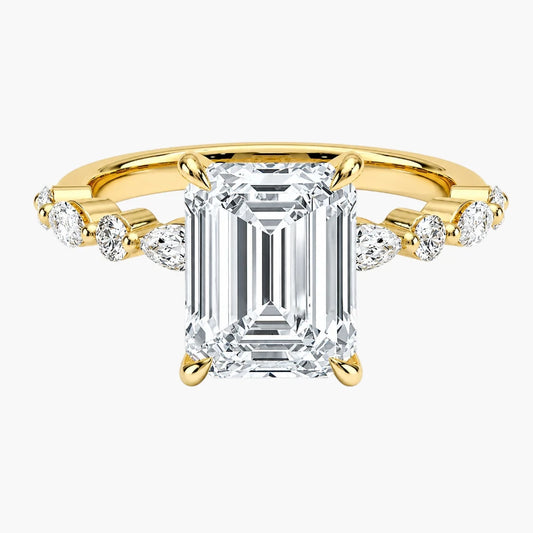
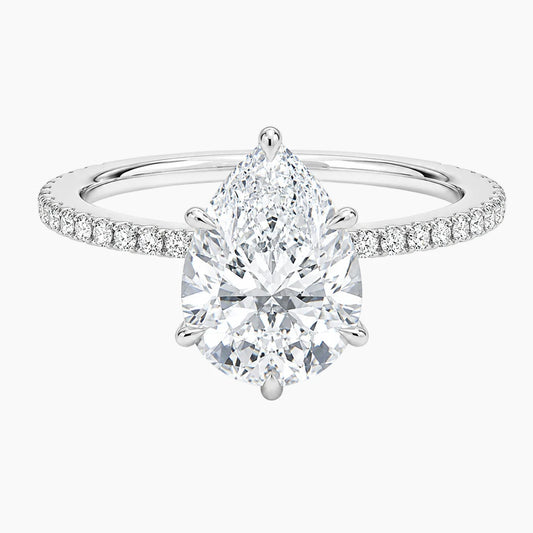
For example, a low-profile solitaire may feel understated and practical, while a hidden halo can introduce additional detail without changing the overall silhouette from above.

Instead of asking only “How large is the stone?”, consider whether the complete design suits your style and everyday routine.


8. Is Moissanite a Sustainable Choice?

Moissanite used in modern jewelry is generally lab-created, so producing the gemstone does not require traditional gemstone mining.

However, sustainability is broader than a single material. Energy use, manufacturing, metals, packaging, transportation, and product longevity can all contribute to the overall impact of jewelry.

At STDIAM, we take a considered approach to these areas, including the use of lab-created gemstones, reduced-plastic packaging where practical, and our signature walnut wood jewelry box.

Through our One Order, One Tree initiative, we also support the planting of one tree with every order through our partnership with Tree-Nation.

We see responsible practices as something to keep improving rather than a single claim attached to a product.


9. Who Is Moissanite Best Suited For?

Moissanite may be worth considering if you:

  • Enjoy strong brilliance and noticeable fire
  • Want a gemstone suitable for frequent wear
  • Prefer a generally lower price point than comparable diamond jewelry
  • Want more flexibility in stone size or setting design
  • Appreciate lab-created gemstones
  • Like moissanite for its own optical character rather than simply as a substitute for diamond

It may be less suitable if your priority is specifically owning a diamond, matching diamond's exact optical appearance, or following traditional diamond grading conventions.


The Bottom Line

Moissanite can be an excellent diamond alternative, but its value is not simply that it costs less.

Its appeal comes from the combination of brilliance, durability, design flexibility, and its own distinct identity as a gemstone.

The best choice is not necessarily the gemstone with the highest price, the largest size, or the strongest sparkle. It is the one whose appearance, properties, and design align with the way you want to wear your jewelry.

Explore our moissanite rings, or continue learning with our Moissanite vs. Diamond Guide.

Articolo precedente
Prossimo articolo

Lascia un commento

Tutti i commenti del blog vengono controllati prima della pubblicazione

Grazie per esserti iscritto!

Questa email è stata registrata!

Acquista il look

Scegli le opzioni

Modifica opzione

Scegli le opzioni

this is just a warning
Login
Carrello della spesa
0 elementi